Overview
Forter Agentic Orchestration
The orchestration layer that connects your commerce stack to the AI shopping revolution.
What is Agentic Commerce?
A new paradigm where AI agents discover, evaluate, and purchase products on behalf of consumers.
For two decades, e-commerce followed a consistent pattern: consumers visit websites, search for products, add items to carts, and complete checkout forms. This model required buyers to navigate multiple sites, compare options manually, and handle payment details themselves.
Agentic commerce fundamentally changes this.
Instead of browsing websites, consumers describe what they want in natural language. An AI agent—like ChatGPT, Google Gemini, or Perplexity—interprets the request, searches across merchants, compares options, and can complete the purchase within the same conversation.
Traditional vs. Agentic Shopping
Aspect | Traditional E-commerce | Agentic Commerce |
|---|---|---|
Discovery | Consumer searches multiple websites | AI agent queries product catalogs |
Evaluation | Manual comparison across tabs | Agent synthesizes options and recommends |
Selection | Consumer clicks "Add to Cart" | Agent confirms selection with user |
Checkout | Fill forms, enter payment info | Agent handles checkout via secure APIs |
Interface | Web browsers, mobile apps | Conversational (chat, voice) |
Example Interaction
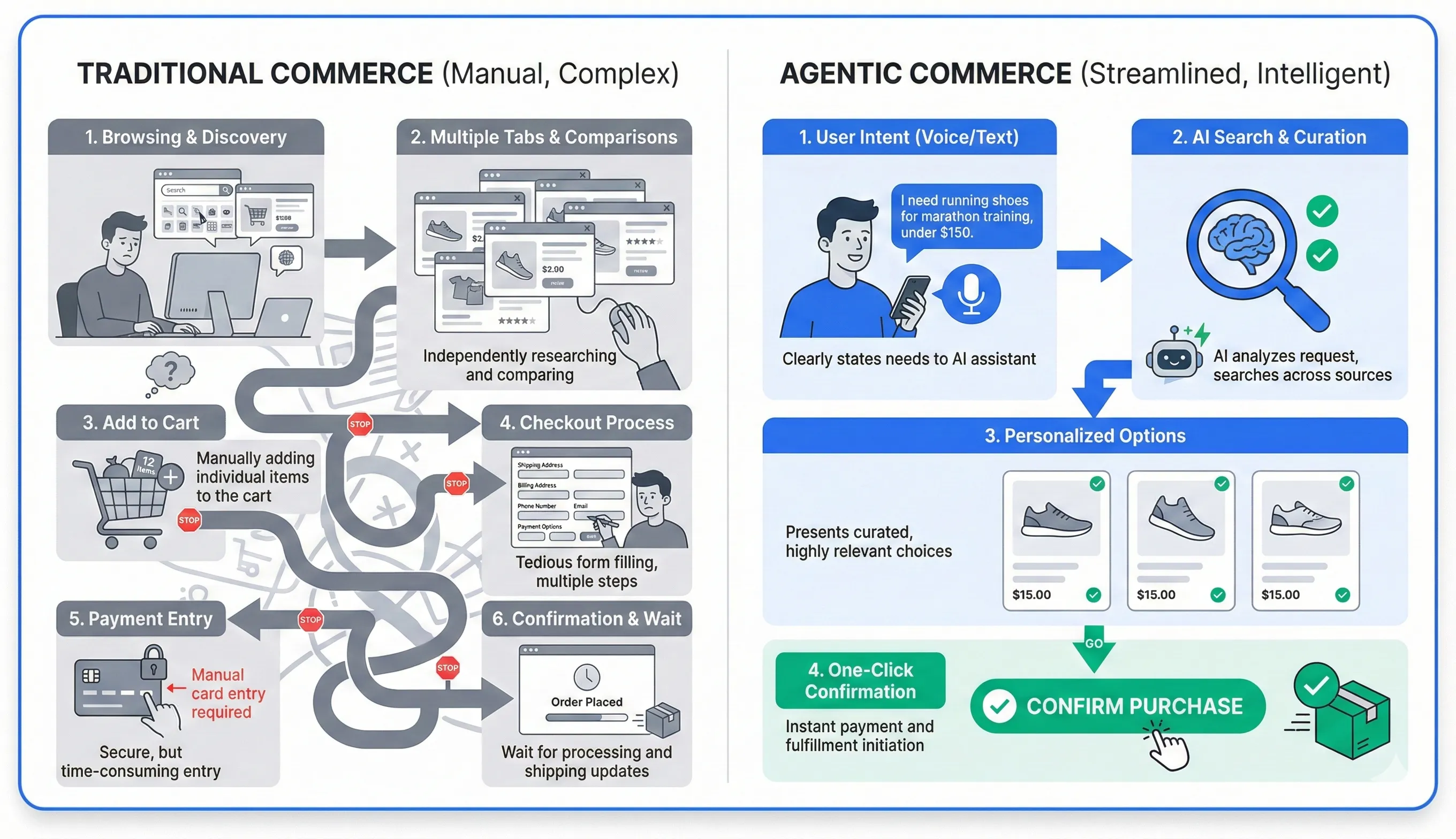
Traditional:
- Open browser, go to Amazon
- Search "wireless noise-canceling headphones"
- Scroll through results, open 5 tabs
- Read reviews, compare specs
- Add to cart, enter shipping address
- Enter credit card, complete purchase
Agentic:
The AI agent searches multiple merchants, filters by criteria, presents top 3 options with pros/cons, and completes the purchase upon confirmation—all in one conversation.
The Challenge
AI shopping agents like ChatGPT, Google Gemini, and Perplexity are becoming the new storefront. But these platforms require:
- Structured product data optimized for LLM comprehension
- Real-time inventory to prevent hallucinations and failed purchases
- Secure checkout flows that work within conversational interfaces
- Protocol compliance with emerging standards like the Agentic Commerce Protocol (ACP)
Building this infrastructure in-house requires significant engineering investment across multiple evolving platforms—each with different specifications and requirements.
The Solution
Forter Agentic Orchestration acts as a unified orchestration layer between AI platforms and your existing commerce backend.
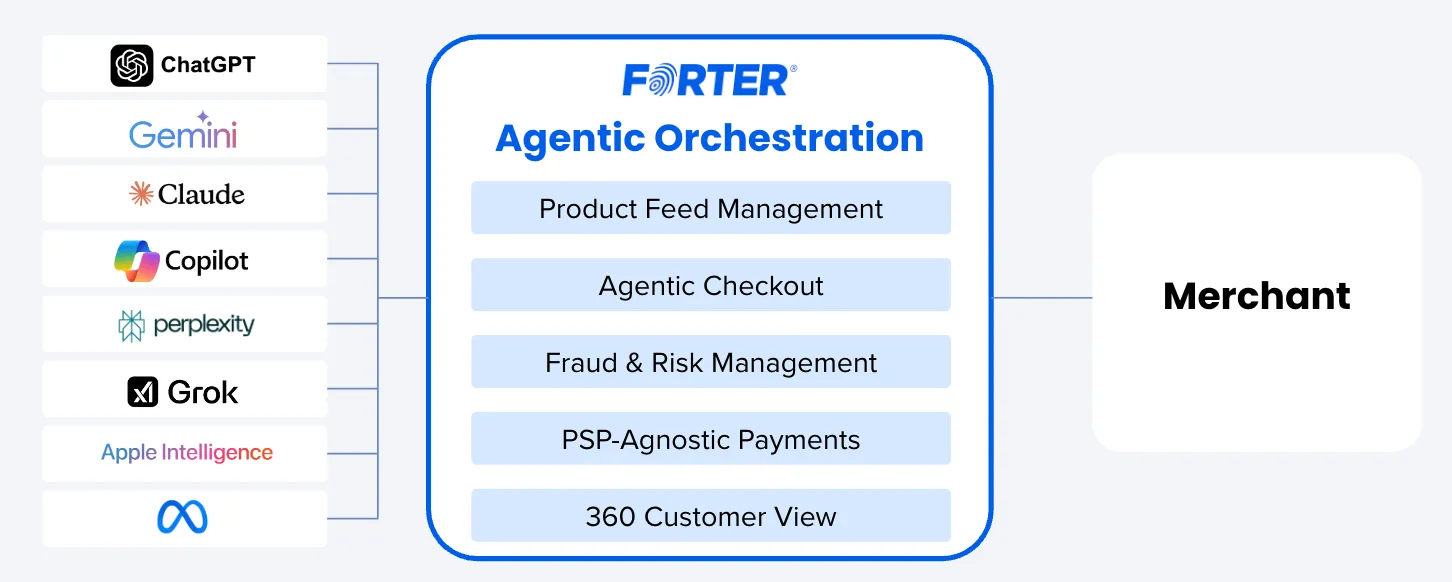
Choose Your Integration Path
Forter supports three integration methods based on your e-commerce platform:
- Shopify Integration - For Shopify merchants
- Forter pulls your catalog via Shopify Admin API
- Orders are created directly in Shopify via Draft Orders API
- You provide: Admin API Access Token
- SFCC Integration - For Salesforce Commerce Cloud merchants
- Forter pulls your catalog via OCAPI Shop API
- Orders are created directly in SFCC via OCAPI Basket/Order APIs
- You provide: OCAPI Client ID and Secret
- Custom Integration - For custom platforms or other e-commerce systems
- You host a product feed at a stable URL
- Forter calls your webhook endpoint with completed orders
- You provide: Feed URL + Webhook endpoint
Key Capabilities
1. Unified Catalog Ingestion
Connect your existing e-commerce platform without restructuring your backend:
- Shopify — Direct integration via Admin API (no feed needed)
- SFCC — Direct integration via OCAPI (no feed needed)
- Custom Platforms — Host your feed in Google Merchant Center XML, Shopify CSV, or JSON format
2. Semantic Transformation
Transform product data for AI comprehension:
- Intent extraction — Surface use-cases and compatibility
- Taxonomy normalization — Universal category mapping
- Attribute enrichment — Extract hidden attributes (BPA-Free, TSA-Approved)
3. Real-Time Inventory Sync
Prevent over-selling and inventory hallucinations:
- Live state synchronization — Webhooks and API updates
- Timestamped proofs — Agents receive freshness guarantees
- Safety buffers — Reserve stock thresholds for high-velocity scenarios
POST /v1/inventory
Authorization: Bearer {api_key}
Content-Type: application/json

{
  "id": "SKU-001",
  "quantity": 15,
  "availability": "in_stock"
}
4. Secure Checkout Orchestration
End-to-end transaction handling with PCI compliance:
- Session management — Stateful checkout lifecycle
- Tax calculation — US nexus rules, category-specific rates
- Payment tokenization — PCI-compliant vault for sensitive data
- Order proxying — Inject orders directly into your fulfillment system
Why Forter Agentic Orchestration?
The Agentic Commerce Challenge
Enabling AI agents to transact on behalf of consumers requires solving multiple interconnected problems:
Challenge | What's Involved |
|---|---|
Multi-Platform Complexity | Each AI platform (OpenAI, Google, Perplexity) has different API specs, authentication flows, and data requirements—and these are evolving rapidly |
Payment Security | PCI-compliant tokenization and payment processing within conversational interfaces |
Catalog Optimization | Product data structured for LLM comprehension, not just traditional search |
Inventory Accuracy | Real-time stock levels to prevent AI hallucinations and failed purchases |
Tax Compliance | US sales tax calculation across jurisdictions and product categories |
Fraud Prevention | New transaction patterns require new risk models—agentic purchases look different from traditional e-commerce |
Why Forter
Forter brings unique advantages to agentic commerce:
Fraud Expertise in New Paradigms
Agentic transactions have different risk signals than traditional e-commerce. Forter's Identity Intelligence network—processing billions of transactions across thousands of merchants—provides the data foundation to distinguish legitimate AI-assisted purchases from fraud. This isn't a new fraud model built from scratch; it's an extension of proven infrastructure.
Merchant Network Effects
Catalog intelligence improves as more merchants connect. Product taxonomy normalization, attribute enrichment, and availability patterns benefit from aggregate data across the Forter network.
Protocol Evolution
Standards like ACP are still emerging. Forter's dedicated focus on commerce infrastructure means active participation in protocol development and rapid adaptation as specs change—without requiring integration updates from merchants.
What This Means for You
- Single integration — Connect your catalog and configure your backend once
- Immediate reach — Products become discoverable across AI shopping platforms
- Ongoing compatibility — Protocol updates and new platforms handled automatically
- Unified protection — Same fraud prevention trusted by leading e-commerce merchants
The Agentic Commerce Protocol (ACP)
To enable AI agents to transact with merchants, standardized protocols are emerging. The most significant is the Agentic Commerce Protocol (ACP), co-developed by OpenAI and Stripe.
What ACP Defines
- Product Feed Specifications — How merchant catalogs should be structured for AI consumption
- Checkout Session APIs — Endpoints for creating and managing purchase sessions
- Payment Delegation — Secure handling of payment credentials within AI contexts
- Order Completion — Finalizing transactions and returning confirmation to agents
Why Protocols Matter
Without standardization, each AI platform would require different integrations:
- OpenAI's ChatGPT uses one API format
- Google Gemini expects another
- Perplexity has its own requirements
Protocols like ACP create a common language that orchestrators (like Forter Agentic Orchestration) can implement once and expose to all platforms.
How It Works
When a customer purchases through an AI agent:
- Customer initiates purchase — The customer tells ChatGPT, Gemini, or another AI assistant they want to buy a product
- Forter validates the order — We verify product availability against your catalog and calculate shipping options
- Tax is calculated — Based on your nexus configuration, Forter computes accurate sales tax
- Payment is processed — The AI platform securely collects payment; Forter processes it through your configured PSP
- Order is delivered to you — The completed order is sent to your backend via your configured integration
Why Merchants Should Care
New Customer Acquisition Channel
AI assistants are becoming the primary interface for millions of consumers. Being discoverable by AI agents means access to customers who may never visit your website directly.
Reduced Purchase Friction
Conversational commerce eliminates the traditional checkout friction:
- No account creation required
- No form filling
- Payment handled securely via delegated credentials
- Faster time-to-purchase
Competitive Differentiation
Early adopters of agentic commerce gain visibility in AI recommendations before the market becomes saturated. AI agents prioritize merchants with:
- Well-structured product data
- Real-time inventory accuracy
- Reliable checkout APIs
Higher Conversion Potential
When an AI agent recommends your product, the consumer is already in a high-intent state. The seamless checkout flow reduces abandonment compared to traditional cart-based purchases.
The Future of Shopping
Agentic commerce represents a fundamental shift in how consumers interact with merchants. As AI assistants become more capable and consumer trust grows:
- Discovery will be conversational — "Find me..." replaces search boxes
- Comparison will be synthesized — AI handles the research humans used to do
- Checkout will be invisible — Transactions complete within conversations
- Loyalty will be mediated — AI agents may develop preferences based on reliability and user satisfaction
Merchants who prepare their infrastructure today will be positioned to capture this emerging channel.
Getting Started
Choose your integration path based on your e-commerce platform:
- Shopify merchants → Shopify Integration Guide
- SFCC merchants → SFCC Integration Guide
- Other platforms → Custom Integration Guide
Or start with the Quickstart Guide to choose the right path.
Next Steps
- Quickstart Guide — Choose your integration path
- Catalog & Inventory — Product data synchronization
- Checkout & Payments — Payment processing and order management
- FAQ — Common questions